

McGilchrist continues his slog through the neurological evidence for his argument. The footnotes provide 535 references for this chapter alone. I am grateful for his efforts because, undoubtedly, most of this data is beyond my ability to understand without such a commentary.
He has argued up to this point that human bihemispheric neurology results in divergent modes of attending to the world. In chapter two, McGilchrist deepens his examination of these divergent modes by discussing them in terms of a series of opposites. The first third of the chapter highlights the following:
- Breadth and flexibility versus focus and grasp
- The new versus the known
- Possibility versus predictability
- The hierarchy of attention
- The whole versus the part
I’ve selected relevant passages below, offering comments and making connections where needed.
Breadth and flexibility and focus and grasp
Different aspects of the world come into being through the interaction of our brains with whatever it is that exists apart from ourselves, and precisely which aspects come into being depends on the nature of our attention. It might turn out that for some purposes, those that involve making use of the world and manipulating it for our benefit, we need, in fact, to be quite selective about what we see. In other words we might need to know what is of use to us – but this might be very different from understanding in a broader sense, and certainly might require filtering out some aspects of experience. Without experiencing whatever it is, we would have nothing on which to ground our knowledge, so we have to experience it at some stage; but in order to know it, we have to ‘process’ experience. We have to be able to recognise (‘re-cognise’) what we experience: to say this is a ‘such-and-such’, that is, it has certain qualities that enable me to place it in a category of things that I have experienced before and about which I have certain beliefs and feelings. This processing eventually becomes so automatic that we do not so much experience the world as experience our representation of the world. The world is no longer ‘present’ to us, but ‘re-presented’, a virtual world, a copy that exists in conceptual form in the mind.” (1)
In the first part of this passage, McGilchrist continues to discuss how needs, values, attending and things relate, but he goes on to take up the difference between our initial experience and our subsequent processing of that initial experience. This language is highly reminiscent of John Dewey’s distinction between primary and secondary, or reflective, experience, as well as parallels the initial elements of Lonergan’s cognitional structure. More specifically, the three levels of Lonergan’s cognitional structure are experience, understanding, and judgment. The moment from experience to understanding is characterized by asking of the content of experience, “What is it?” The pause, coupled with ensuing study resembles McGilchrist’s processing of experience in order to know it, as well as mirrors the drive “to say this is a ‘such-and-such'”.
From McGilchrist:
Much of our capacity to ‘use’ the world depends, not on an attempt to open ourselves as much as possible to apprehending whatever it is that exists apart from ourselves, but instead on apprehending whatever I have brought into being for myself, my representation of it. This is the remit of the left hemisphere, and would appear to require a selective, highly focused attention. (2)
McGilchrist has already referred to how the analytic objects of the left hemisphere comprises “a sort of self-reflective virtual world” (3). Here he refers to them as a representations which we have brought into being for our own use and purposes.
He also discusses five experimentally identified kinds of attention: vigilance, sustained attention, alertness, focused attention, and divided attention. Here is his conclusion regarding them:
To sum up, the right hemisphere is responsible for every type of attention except focused attention. Even where there is divided attention, and both hemispheres appear to be involved, it seems probable that the right hemisphere plays the primary role… More specifically there is evidence of left-hemisphere dominance for local, narrowly focused attention and right-hemisphere dominance for broad, global, and flexible attention. (4)
The new versus the known
Given what has been presented thus far, McGilchrist says, “in almost every case what is new must first be present in the right hemisphere, before it can come into focus for the left.” (5)
Anything newly entering our experiential world instantly triggers a release of noradrenaline mainly in the right hemisphere. Novel experience induces changes in the right hippocampus, but not in the left. So it is no surprise that phenomenologically it is the right hemisphere that is attuned to the apprehension of anything new. […] Not just new experience, but the learning of new information or new skills also engages right-hemisphere attention more than left, even if the information is verbal in nature. However, once the skills have become familiar through practice, they shift to being the concern of the left hemisphere, even for skills such as playing a musical instrument. (6)
The left hemisphere, then, deals with what is already known, or routine. As was cited above, the known is apart of processed experience, or what we re-present to ourselves.
Possibility versus predictability
The most interesting part of this section is new (to me) terminology that McGilchrist uses, which I need to learn more about. Frame shifting, or set-shifting, seem to be the terms in cognitive psychology for shifting between tasking (wiki here). This function falls within the right hemisphere’s domain, which makes sense given that new experiences would first stimulate the right hemisphere, which would then decide how best to attend to the subject matter.
The right hemisphere is, in other words, more capable of a frame shift; and not surprisingly the right frontal lobe is especially important for flexibility of thought, with damage in that area leading to perseveration, a pathological inability to respond flexibly to changing situations. For example, having found an approach that works for one problem, subjects seem to get stuck, and will inappropriately apply it to a second problem that requires a different approach – or even, having answered one question right, will give the same answer to the next and the next. It is the right frontal cortex that is responsible for inhibiting one’s immediate response, and hence for flexibility and set-shifting, as well as the power of inhibiting immediate response to environmental stimuli. (7)
I wonder if one can speak of philosophical perseveration which might be described as “a philosophical inability to respond flexibly to changing situations.” Hmm. At any rate, it seems important that the right hemisphere is responsible for determining the context, or frame, in which we respond to a situation or experience. Perhaps a left hemispheric treatment is in order…or perhaps not. The implication alone that not all situations require a left hemispheric response is instructive.
The hierarchy of attention
It should be clear by this point that there is a hierarchy, or a power ranking, between the two modes of attention and the hemispheres.
If whatever is new to experience is more likely to be present in the right hemisphere, this suggests a temporal hierarchy of attention, with our awareness of any object of experience beginning in the right hemisphere, which grounds experience, before it gets to be further processed in the left hemisphere. This coexists with and is confirmed by a hierarchy of attention at any one moment in time, which also establishes the right hemisphere, not the left, as predominant for attention. Global attention, courtesy of the right hemisphere, comes first, not just in time, but takes precedence in our sense of what it is we are attending to; it therefore guides the left hemipshere’s local attention, rather than the other way about. (8)
This hierarchy, or the first-right, then-left order, of cognition supports the philosophical ordering of experience in Lonergan. For Lonergan, objects are experienced as they relate to us before they are engaged analytically, which is the domain of the left hemisphere.
But why does this matter? What’s the big deal? And why would anyone write a dissertation about such a thing? Because awareness of this hierarchy, or the right–>left order of cognition, is absent from much of the history of Western philosophy. Instead, the processes of the left hemisphere have been treated as primary. Its objects have been reified, or taken as given. McGilchrist alludes to how this happened:
We may think that we build up a picture of something by a process of serial scanning – putting the bits together – because this is the way our conscious, verbal left hemisphere, when asked to work out how it is done after the fact, accounts for it. But in reality we see things first whole: serial attentional processing is not needed. In other words, we do not have to orientate our attention to each feature of an object in turn to understand the overall object; the features are all present without the need to combine the products of focal attention. (9)
The whole versus the part
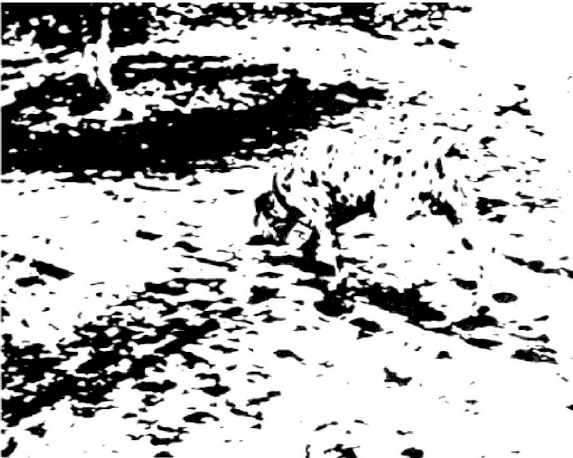
The right hemisphere sees the whole, before whatever it is gets broken up into parts in our attempt to ‘know’ it. Its holistic processing of visual form is not based on summation of parts. On the other hand, the left hemisphere sees part-objects. The best known example of this process of Gestalt perception is the way in which the Dalmatian dog, sniffing the ground in the shade of a tree, suddenly emerges from this mass of dots and splashes. The process is not a gradual putting together of bits of information, but an ‘aha!’ phenomenon – it comes all at once. (10)
Here, McGilchrist Gestalt perception is very much like insight, which for Lonergan is “neither an actually given datum of sense nor a creation of the imagination but an intelligible organization that may or may not be relevant to data” (11). But beyond that exciting connection, and more to the point, we see the whole of our experience before we see the parts of it, generally speaking.
I’ll leave this here.
Notes:
(1) McGilchrist, p. 38.
(2) ibid., p.38.
(3) ibid., p.6.
(4) McGilchrist, p. 39.
(5) ibid., p. 40.
(6) ibid., p. 40.
(7) ibid., p. 40-1.
(8) ibid., p. 43.
(9) ibid., p. 44.
(10) ibid., p. 46-7.
(11) Bernard Longeran, Method in Theology, 10.
 Dissertating Outloud
One thought on ““What do the Two Hemispheres ‘Do'” in The Master and his Emissary by Iain McGilchrist (part I)”