
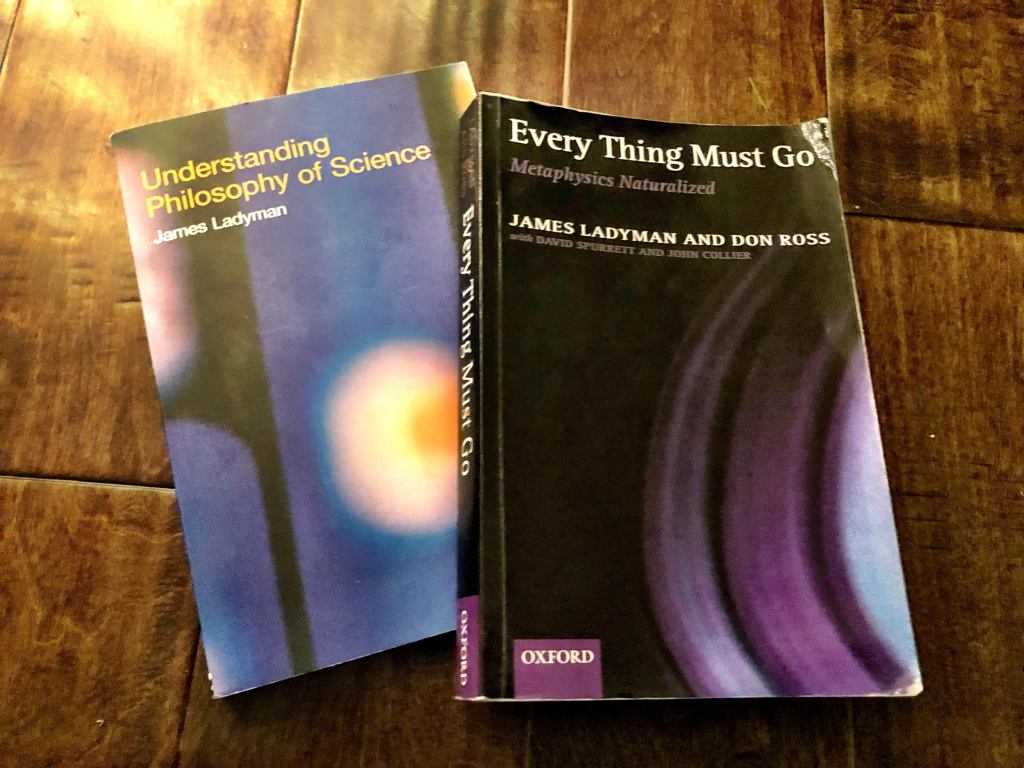
I have written of Ladyman and Ross’s neopositivist commitments in terms of the separation of the context of discovery from the context of justification. Now, I want to deepen this assessment in light of Siegel’s criticism of Quine.
The separation hinges on the following question: where does the epistemological action take place?
The neopositivists claim it takes place in justification while the naturalists claim it takes place in discovery, or rather, that epistemology should be transformed into a discipline studying the psychological or neurological mechanics of belief acquisition.
Following Siegel, then, there is:
- Epistemology as “understanding the psychological mechanisms by which scientific theories are produced” (1) or
- Epistemology as “understanding the criteria by which we select one link [between observation and scientific theories] over and against other links” (2)
The first is the concern of naturalists while the second is the concern of neopositivists.
Also following Siegel, another way to look at this difference is to say that naturalists do not care to address epistemological questions that fall outside the purview of psychology or neuroscience, or do not care about 2. above. In other words, if the question is not subject to the domain of scientific inquiry, then it’s not an epistemological concern. This is a strong identification of epistemology with science.
But this makes Ladyman and Ross’s explicit defense of scientism all the stranger since epistemological formulations of scientism cannot be analyzed by science and are, therefore, by definition, extrascientific in nature.
Ladyman and Ross acknowledge that their scientism is an epistemological claim, but its hard to see how it is also a scientific claim:
Since science just is our set of institutional error filters for the job of discovering the objective character of the world – that and no more but also that and no less – science respects no domain restrictions and will admit no epistemological rivals (such as natural theology or purely speculative metaphysics). With respect to anything that is a putative fact about the world, scientific institutional processes are absolutely and exclusively authoritative. (3)
They advocate for naturalizing epistemology in Quinean fashion, yet also advocate for the exclusive epistemological authority of science, which is an extrascientific claim that cannot be adjudicated by scientific norms or institutions.
I contend that it is difficult to see how one can identify epistemology with science while simultaneously making extrascientific, epistemological claims about science without falling into contradiction. The desire to dissolve extrascientific questions of epistemological justification (i.e. naturalism) and the desire to provide extrascientific, epistemological justification for science (i.e. neopositivism) are at odds. The content of the extrascientific claims about science are, according to their own naturalism, unjustified hangers-on from logical positivism.
***
There is more work for me to do here. In the previous posts, here and here, I have discussed how Ladyman and Ross’s conflicting neopositivistic and naturalistic commitments confuses their scientism. Yet Ladyman and Ross go to great lengths to distinguish their Pragmatist verificationism from that of the Positivist variety, of which I have said nothing. Examining Pragmatist verificationism will demonstrate their even deeper commitment to Quine’s (and Peirce’s) naturalism while still not fully extricating them from their extrascientific, epistemological commitment.
Notes
- Harvey Siegel, “Justification, Discovery, and the Naturalizing of Epistemology,” p. 319.
- ibid., 319.
- Ladyman and Ross, Every Thing Must Go, p. 28.
 Dissertating Outloud