
Improper method in metaphysics
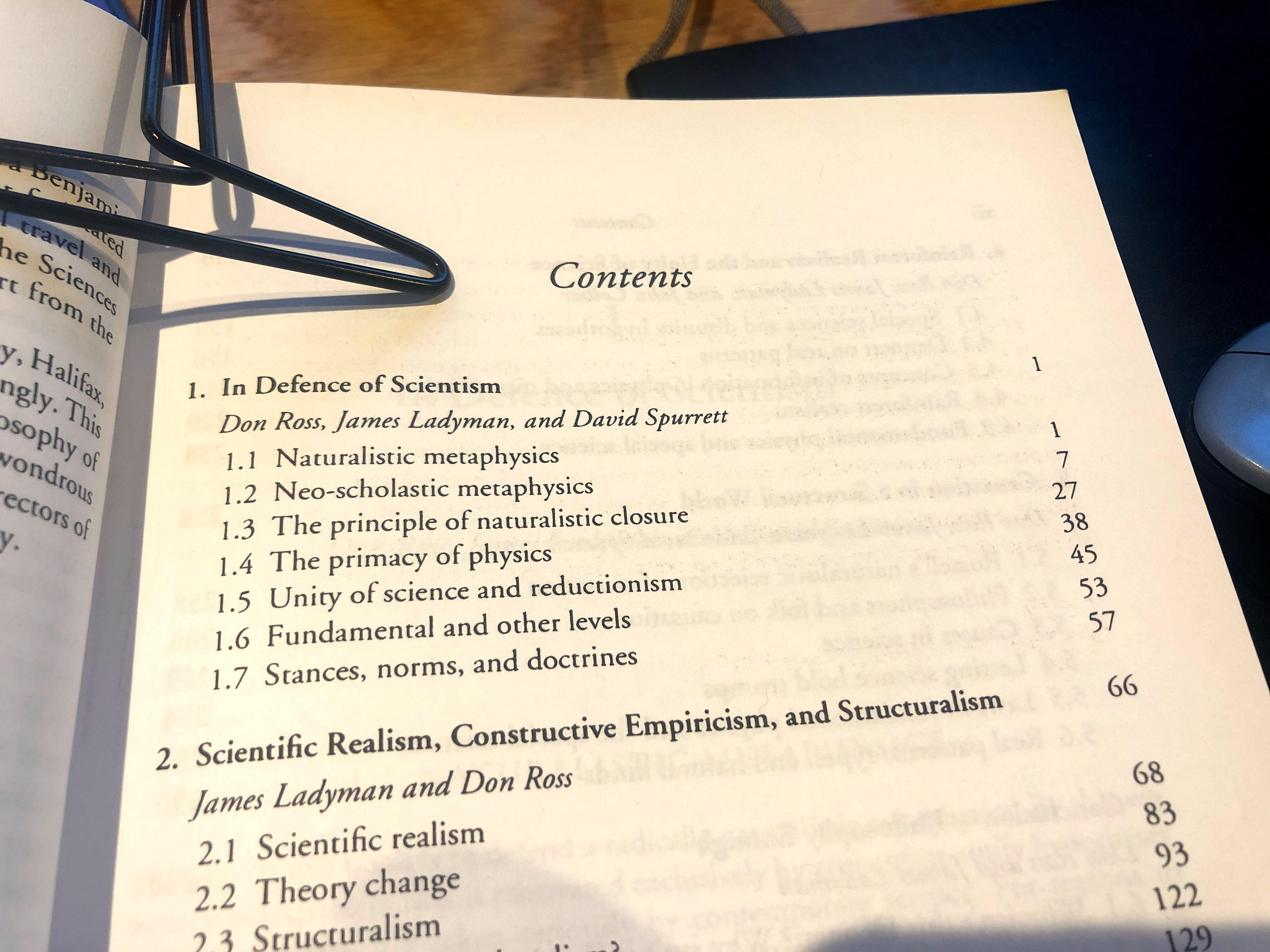
James Ladyman and Don Ross contrast their naturalized metaphysics with contemporary analytic metaphysics. They have a cluster of terms they use to refer to this misconceived form of metaphysics: a priori metaphysics, neo-scholastic metaphysics, and pseudo-scientific metaphysics. The common attribute towards which these designations point is a view that metaphysics investigates the nature of reality independent of the methods and pronouncements of science.
Though, its certainly the case that one would be hard pressed to find a contemporary analytic metaphysician who does not at least claim to take science seriously. Ladyman and Ross, however, note that many such claims amount to mere pretense. They identify three ways in which contemporary analytic metaphysicians “rhetorically emulate science”:
- They ignore science even though it seems to be relevant
- They use outdated or domesticated science rather than our best contemporary science.
- They take themselves to be able to proceed a priori in the investigation of matters upon which they claim science does not bear. (1)
What is wrong with all of this? Ladyman and Ross are very clear:
We see no point in mincing words: it seems to us to be just ridiculous when philosophers look up from their desks and tell us that while sitting there and concentrating they’ve discovered (usually all by themselves) facts about the nature of the world that compete with the fruits of ingenious experimentation conducted under competitive pressure and organized by complex institutional processes. (2)
Proper method in metaphysics
Alternatively, Ladyman and Ross claim that metaphysics should seek “the articulation of a unified world-view derived from the details of scientific research” (3). Metaphysics is a meta-scientific discipline, as there is no particular science which engages in such activity, but it is one which Ladyman and Ross have taken great pains to naturalize.
What, then, is naturalism? Naturalism is a research programme rather than a substantive metaphysical thesis itself; it treats the beliefs that survive the institutional filters of science, and those beliefs alone, as basic sources of evidence (4). “Naturalism requires that, since scientific institutions are the instruments by which we investigate objective reality, their outputs should motivate all claims about this reality, including metaphysical ones” (5).
A naturalized metaphysics, then, will index its claims and descriptions of reality closely to the claims and descriptions of reality produced by scientific institutions and norms. Contrast this sense of metaphysics with the arm-chair style metaphysics of much contemporary analytic philosophy.
Most fully stated, Ladyman and Ross provide their Principle of Naturalistic Closure, or PNC, quoted here without subsequent Stipulations:
Any new metaphysical claim that is to be taken seriously at time t should be motivated by, and only by, the service it would perform, if true, in showing how two or more specific scientific hypotheses, at least one of which is drawn from fundamental physics, jointly explain more than the sum of what is explained by the two hypotheses taken separately… (6)
Notes
- Ladyman and Ross, Every Thing Must Go, p. 17.
- ibid., p. 57.
- ibid., p. 65.
- Stitched together from various sentences found on p. 301.
- ibid., p. 30.
- ibid., p. 37.
 Dissertating Outloud
One thought on “Pseudo-scientific and naturalized metaphysics”