
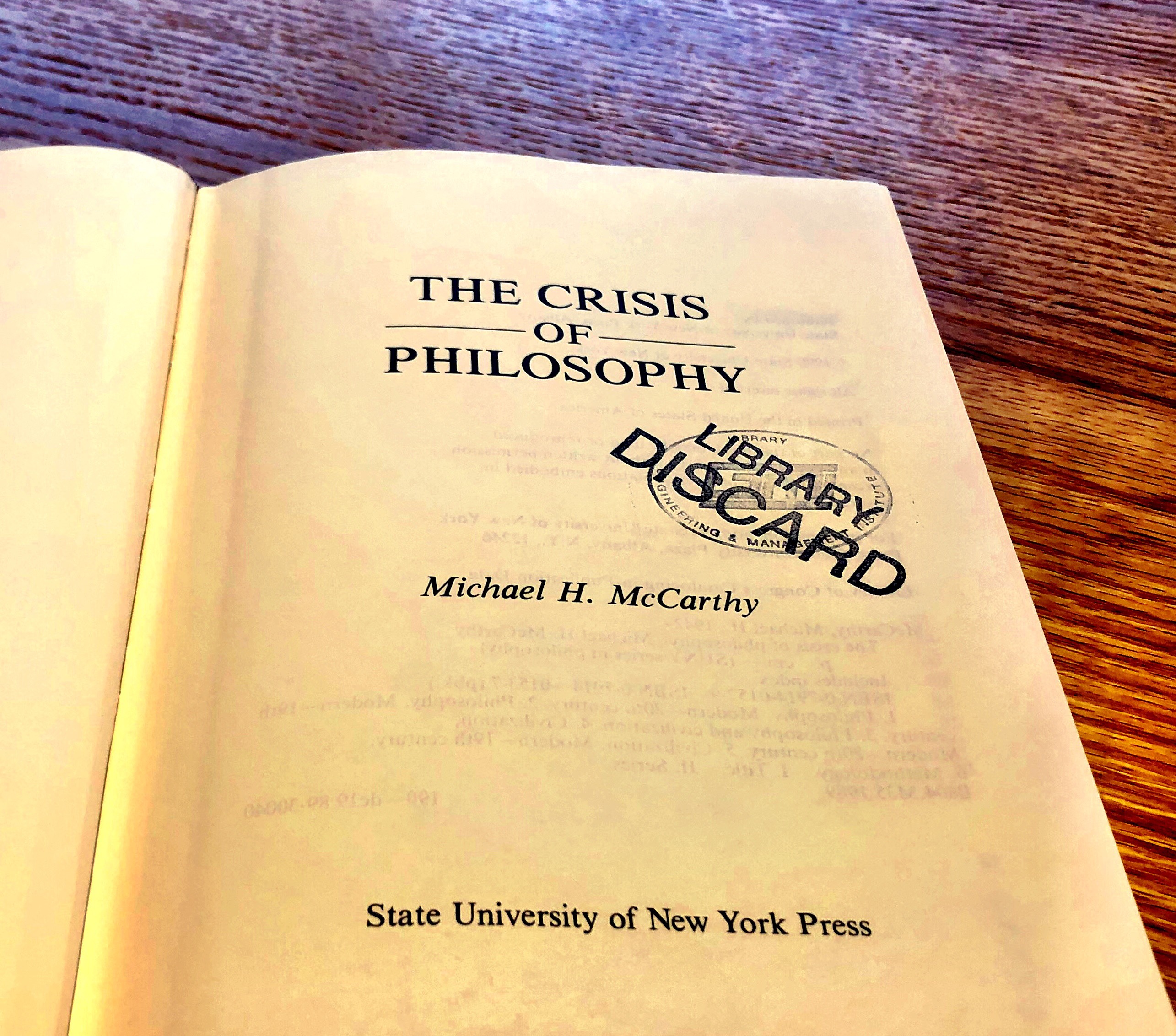
Michael H. McCarthy’s The Crisis of Philosophy has been an invaluable resource for me. I feel all-too-lucky to have obtained a discarded library copy from Amazon.
McCarthy’s book details philosophy’s aimlessness and lack of purpose in the modern era as empirical science gathered to itself more and more of the territory traditionally held by the discipline of philosophy. The more epistemically powerful empirical science grew, the less relevant to philosophy seemed. Thus, we see much 20th century philosophy either commit itself to being the handmaiden of science or commit intellectual suicide through the absurdities of postmodernism.
Classical consciousness
I want to quote McCarthy at length on Aristotle’s conception of science. McCarthy refers to it, following Lonergan, as classical consciousness, which both authors contrast with historical consciousness, or the conception of science that replaced Aristotle’s once his was thoroughly subverted by the development of empirical science. Here is McCarthy, at length:
“By classical consciousness I refer to a conception of theoretical science that dominated Western philosophy from Aristotle to Kant. It is a conception that originates in Greek geometry but was later extended to all the sciences of nature. As thematized by Aristotle in his Posterior Analytics, it holds that scientific knowledge is true, certain, knowledge of causal necessity reached by empirical methods of inquiry and systematized in an axiomatic deductive structure based upon self-evident definitions and principles. Science is conceived as the permanent achievement of truth attained through a disciplined but finite course of individual investigation. Theoretical invariance is to be found in the truths discovered by scientific inquiry, in their logical systematization, and in the objects whose intelligible structure the scientific propositions articulate. As the intelligible structure under investigation is permanent, so are the truths that give scientific expression, mirroring in their logical progression the pattern of causal dependence within the order of being itself.
“A clear distinction is required within this account of science between the order of inquiry and the order of demonstrated knowledge. Science is the goal or telos of theoretical inquiry. It is the acquired epistemic power to demonstrate or deduce the essential truths about a subject matter, a power achieved through the successful completion of the process of discovery. As long as exploratory inquiry continues within a specific discipline, the ideal of science has not been achieved. According to Aristotelian principles, the nature of any reality is disclosed fully in its completed form (its eidos is revealed in its telos). A philosophical theory of science should articulate its constitutive essence; to do so it must be based on an examination of knowledge in its logically perfected state. To understand the oak tree you look at the mature specimen rather than the acorn; you look to the end or completion of the process not its origin or stages of development.
“Though Aristotle had a nuanced sense of empirical inquiry, the theory of science outlined in his logic focuses not on the ongoing process of discovery but on the permanent achievement to which it ideally leads. The impression given by the Organon as a whole is that scientific knowledge is a difficult but attainable objective, that it is an individual accomplishment admitting of closure and finality. Because of this expectation of closure, the acquisition of scientific knowledge brings certainty. Cognitive certitude and finality are necessary though not sufficient conditions of science. The truths of science, though discovered individually, can be taught to others as part of a timeless, permanent, public fund of knowledge. Because the conclusions of science are founded on the intuitively evident principles reached through inquiry, direct challenge to the truth of those principles puts the claim to science in jeopardy. The public dimension of science is compromised if the axiomatic principles of knowledge lose their compelling evidence. A central epistemic dilemma posed by this theory is the validation of axioms whose intuitively evident truth is denied. Whereas Aristotle recognizes that insight into first principles is the epistemic fruit of sustained investigation, he does not seem to anticipate the problem posed by alternative sets of explanatory axioms. His is an innocent confidence that foundational truths exist, that they admit of eventual discovery, and that their truth and explanatory priority will compel rational assent.” (1)
Numerous elements from this conception of science continue to shape contemporary debates in philosophy of science. While particular elements have been cast aside – for example, almost no one argues that scientific knowledge grants certitude in the manner that either Aristotle or Descartes would have suggested (albeit very differently) – consider how “scientific knowledge is…systematized in an axiomatic deductive structure based upon self-evident definitions and principles” for Aristotle. Does this not sound like the still influential model of scientific explanation articulated by Carl Hempel’s deductive-nomological (D-N) model from 1965? (2)
Additionally, Aristotle’s distinction between the order of inquiry and the order of demonstrated knowledge, which does not map perfectly onto the context of discovery and context of justification distinction, is nonetheless an ancient ancestor of 19th century, and contemporary, debates about the relationship between psychology and logic.
My point is simply that elements of Aristotle’s conception of science, a conception of science explicitly rejected by the modern scientific conception, have been smuggled into many contemporary debates. As McCarthy goes on to argue, many of the epistemic difficulties in contemporary philosophy of science originate from unconscious attempts to reconcile elements of the classical model of science with the contemporary model.
This suggests one of two things: either the break between the Aristotelian and modern conceptions is not as clean as the standard history claims it is, or there are certain perennial considerations raised by Aristotle that cannot be so easily dispensed with.
Notes:
- Michael H McCarthy, The Crisis of Philosophy (Albany: SUNY Press, 1990), 6 – 7.
- Henk W. de Regt, Understanding Scientific Understanding (Oxford: Oxford University Press, 2017), 25.
 Dissertating Outloud
3 thoughts on “Aristotle’s conception of science”