
I am trying to flesh out the following argument at length: Aristotle mathematized science by modeling knowledge upon ancient geometrical reasoning. Much like Euclid’s Elements after him, Aristotle envisioned knowledge as having an axiomatic-deductive structure. Granted, this was his description of a final, complete science rather than our contemporary, fallibilist conception of scientific inquiry, but nonetheless, Aristotle defined this classical notion of science, which was influential for nearly two thousand years.
I contend that this classical conception of science as an axiomatic-deductive structure was heavily influential on both Frege and the logical positivists. Their chosen philosophical method of logical analysis attempted to fit modern scientific theories into the classical scientific framework. Rather than use a static, axiomatically and deductively structured science and logic to account for a scientific method accustomed to upheaval in research programs, a more dynamic and heuristic pattern of inquiry needs to be articulated. Basically, one should not use a tool appropriate to final science, namely logic, when that science is still developing. It’s simply not up to the task.
The passages below (on logic) from Ackrill’s work help support portions of my argument by highlighting the mathematic, axiomatic-deductive structure of Aristotle’s science. Additionally, I want to delve into Ackrill’s work for a comprehensive understanding of Aristotle’s scientific framework, which is where I begin below.
[But first, let me offer this disclaimer. I explicitly intend to compare Aristotle’s conception of science/knowledge to the conception of science/knowledge used by Frege, the logical positivists, and those others influenced by them. However, while Aristotle’s conception of science is grounded in his metaphysics, Frege and the logical positivists did not ground their similar conception of science in Aristotle’s metaphysics. This means that Aristotle’s conception of science as presented here is divorced from his metaphysics and is evaluated against the range of natural phenomenon that contemporary science investigates.]
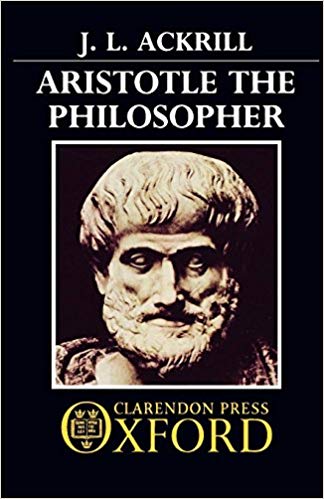
J. L. Ackrill’s Aristotle the Philosopher
On Demonstration and scientific knowledge:
Below is Ackrill’s concise description of Aristotle’s concept of demonstrative scientific knowledge. One begins from Definitions, Existence-propositions, and General logical truths and then, through the construction of valid syllogisms, can deduce other propositions from one’s premises.
Any science will, according to Aristotle, have certain starting-points: definitions, existence-propositions and general logical truths. (Compare the starting-points of Euclid’s geometry: definitions, postulates and ‘common principles’.) None of these starting-points will itself be demonstrable; they will have to be grasped in some other way. The definitions will be ‘real’ definitions, not just verbal ones: they will give the inner or essential nature of those natural kinds that the science is about. From them will be deduced by valid syllogisms further characteristics that things of such kinds necessarily have in virtue of their essential nature. The starting-points are, as it were, the axioms of the science, and the demonstrated truths are its theorems. To have acquired a scientific knowledge or understanding of some proposition is to have demonstrated it, that is, deduced it validly from premises which are true and necessary, and which are the genuine ’causes’ (i.e. are genuinely explanatory) of the conclusion in question. (1)
But where do the starting points come from? From whence come the ‘true and necessary’ definitions that form the premises? According to Aristotle, the definitions that serve as the starting points of science begin with sense-perception:
This capacity does in fact belong to all animals, since they have an inborn power of discernment, which is what is called perception. In some animals retention of the percept occurs, in others it does not. For those in which it does not occur…there is no knowledge outside the perceiving; but others can, after perceiving something, still hold it in their minds. And after many such occasions a further difference comes about: some come to have a logos [an ‘account’ or general idea] from retaining such things, while others do not.
From perception, then, there comes memory, and from memory – when memory of the same thing occurs often – experience; for many such memories make a single experience. And from experience, or from the whole universal that has come to rest in the mind – the one distinct from the many, whatever is one and the same in all the various things – there comes a principle of skill or scientific knowledge, of skill if it concerns becoming, of scientific knowledge if it concerns what is.
Thus the states in question [i.e. of knowing the starting-points] neither belong in us already in a determinate form, nor come about from other states that are more highly cognitive than they; but they come about from perception. It is as a battle when a rout occurs: if one man makes a stand another does and then another, until they reach their starting-point… The mind is of such a nature as to be capable of this.
What we have just said but not said clearly, let us say again. When one of the undifferentiated things [infimae species, like man or horse] makes a stand, a first universal is in the mind; for what one perceives is the particular thing, but perception is of the universal – e.g. of a man, not of Callias the man… Again a stand is made in these, until the uncompounded universals stand – such and such an animal, then animal, and so on. Clearly, therefore, it is by induction that we have to get to know the first things. For that is how perception too implants the universals in us. (2)
Aristotle calls the power by which we perceive such starting-points or first things nous:
Of the intellectual dispositions by which we grasp truth, some are always true, while others (such as opinion and reasoning) can be false. Scientific knowledge and nous are always true, and no kind of state except nous is more accurate than scientific knowledge, and the starting-points of demonstrations are more knowable than their conclusions. There cannot, therefore, be scientific knowledge of the starting-points, and since nothing can be more true than scientific knowledge except nous, nous must be of the starting-points. (3)
To summarize thus far: Aristotle’s conception of scientific knowledge is an axiomatic-deductive structure, or proof, or syllogism, that begins with definitions, existence-propositions, and general logic truths and results in scientifically deduced propositions. The definitions are the starting-points, or axioms, of the scientific syllogism. These starting-points become known beginning with sense-perception, proceeding through memory and experience, and culminating in perception of the universal, or form, of some natural kind. The starting-points, or definitions, are arrived at by induction of universals while the scientific propositions are arrived at by deduction from starting-points.
But what method, or procedure, do we use in order to arrive at the starting-points? Aristotle laid out the cognitional steps we proceed through on our way to these starting-points, but what we want is a specific procedure to follow. How do we do it?
Ackrill has the same concern:
Aristotle’s chapter is interesting and has been influential, but it does not go far towards explaining how the starting-points of sciences are to be grasped. What it does explain is the gradual formation in the mind of the general or abstract ideas, the grasp of concepts and of meanings. But the question remains, how can we get from ordinary concepts (derived from sense-experience in the way he described) to the precise and clearly defined terms required for scientific knowledge? How are we to discover – and be sure that we have discovered – the real definitions of natural kinds, or the scientific definitions of such events as eclipses and thunder? (4)
It is not by deduction, but through dialectic. Dialectic is the method of reasoning by which we start at some opinion, observation, or position and evaluate it in light of others until we arrive at the best theory of the phenomenon under consideration.
The procedure of working through endoxa, through discussion of conflicting views and of problems (aporiai), towards something clear and certain, is a procedure that Aristotle often recommends and regularly adopts. (5)
This sounds rather odd to those familiar with modern, experimental science. But Ackrill offers a few further clarifications. On endoxa:
Exdoxa includes not only widely held beliefs of ordinary folks but also the views of any notable groups or distinguished individual. In a relatively ‘scientific’ area, where there are experts who have looked into the facts carefully, the views of experts will naturally be of primary interest, and the opinions of the layman will carry little weight (though we should of course like to understand why these opinions have been adopted). In this way the observed facts on which the experts base their views are – indirectly – fed into the dialectical process. (6)
Ackrill further clarifies the importance of formulating a theory, or description, that preserves the phenomenon, or observable qualities, of the object or event:
Aristotle uses one and the same formula to cover both the explanation of observed facts by scientific laws or theories and the eliciting of clear and consistent concepts from conflicting or confused opinions: he speaks of starting from and ‘saving’ the phenomenon. He can use this formula because the term ‘phenomenon’ (like ‘endoxa’) has a wide range of application It means ‘appearances’ – both in the sense of what may be observed, how things look, etc., and in the sense of what seems to be true, opinions that are held. When Plato in his famous injunction to the astronomers told them to produce the simplest theory that would ‘save the phenomenon’, he referred to the visible astronomical facts, which a good theory had to start from, be consistent with, and explain. But in other enquiries it can be widely held beliefs and things commonly said that are the facts, what we have to start from; and we aim at a ‘theory’ that will enable us to understand why these things are said and believed, and to grasp the system of interrelated concepts that are expressed in, or implied by, these ordinary beliefs and statements. (7)
This, then, is the procedure for obtaining the starting-points, definitions, of scientific knowledge: consider and weigh the theories, or descriptions, of the phenomenon being puzzled over until the best theory is discovered through.
Or presented differently:
- The true and certain knowledge of demonstrative science begins with definitions, existence-propositions, and general logical truths.
- However, the definitions, or starting-points, are not arrived at by demonstrative science.
- The starting-points are perceived universals, or forms, located in perceptible phenomenon.
- The method by which we perceive the universal, or starting-points, is through weighing relevant endoxa against one another.
- Once we have the starting-points, or definitions, we can arrive at other scientific propositions through demonstrative science, which follows an axiomatic-deductive structure.
Let’s look more closely at some of Ackrill’s comments on the axiomatic-deductive structure that is so essential to demonstrative, scientific knowledge for Aristotle.
Aristotle’s mathematization of science
On Aristotle’s Organon:
The treatises in question are logical (in the broad sense of the word), and they were called the Organon – the tool or instrument – because logic was thought to be, not one of the substantial parts of philosophy, like metaphysics or natural philosophy or ethics, but rather a method or discipline useful as a tool in all enquiries, whatever their subject-matter. This is why in the traditional ordering of Aristotle’s works the Organon comes first. (8)
Logic, then, was not a field within philosophy, but the instrument of philosophy.
On Aristotle’s achievement in formal logic:
The very idea of such a science of logic, an idea that now seems so obvious, was a stroke of genius. Plato, as great a philosopher and thinker as Aristotle, and with a high regard for mathematics and its systematic rigour, showed no interest in formalising the arguments and deductions made in ordinary language and in science, and was indeed inclined to regard close attention to details of terminology as a pedantic diversion from serious thought. Formal logic could not get a real start until someone conceived the aim of applying mathematical standards of exactness and rigour to the laying out of the bare bones of deductive arguments.
[…]
Aristotle works hard to satisfy his ideal of logic as an axiomatic system like geometry…In the last century some influential philosophers thought that logic was the study of laws of thought, and consequently found Aristotle’s syllogistic barren and artificial: live thought does not clothe itself in such a strait-jacket. Now we recognize formal logic as allied to mathematics rather than to psychology; and the fact that Aristotle does not ‘psychologise’ logic, but rather ‘mathematises’ it, has become a ground for admiration. (9)
Aristotle launched formal logic by mathematizing it in a rigorous way. Frege, Wittgenstein, and the logicists continued this project, all the while disassociating logic from psychology, following Aristotle’s lead.
Deduction as ‘science’?
The notion that scientists occupy themselves in expounding demonstrative syllogisms based on definitions in indeed laughable. A glance at Aristotle’s own scientific treatises suffices to show that his own scientific work certainly does not have such a form. The notion may have been swallowed by some of his followers, but if we turn to Aristotle himself, we find that the absurdity dissolves. For his theory of demonstration is not offered as an account or theory of how scientists actually proceed when at work, but rather as an outline of the ideal of complete knowledge at which they are aiming. No doubt the structure of proof which he suggests is too limiting. But the idea that a science aims at achieving a theory, as simple as possible, from which will be deducible as many consequences as possible, is a valuable one; and for embodying this view of the nature of a finished science Aristotle’s account of demonstration deserves respect. Ironically enough, this ideal of deducibility is closer to rigorously mathematical theories Aristotle did not know than to the more homely and less quantified theories that were available at his time. (10)
The nature of Aristotle’s science
Above, Ackrill concludes that Aristotle’s science looks a bit more like contemporary mathematics than it does contemporary scientific investigation. And that assessment is hard to argue with.
To be more precise: it seems that Aristotle provides us with a logical framework in which we can insert various descriptions of natural kinds or events. While he intends this framework to be explanatory because his syllogisms incorporate causal descriptions of the phenomenon, it is not truly explanatory because his descriptions are qualitative rather than quantitative.
Those familiar with contemporary science with notice an astounding lack of measurement, or quantification, in Aristotle’s science. Or rather, the mathematics is the wrong kind and in the wrong place. It is of the wrong kind because the operative mathematics in Aristotle’s science is geometry, as his axiomatic-deductive logic is modeled on ancient geometry. It is in the wrong place because the mathematics, or logic in this case, provides the structure for explanation, but no measurement or quantification occurs between observation and formulation of theories.
In the above comments, I don’t mean to weigh Aristotle’s science and find it wanting according to contemporary standards. That’s not my point. But given what we know about the successful structure and method of contemporary scientific investigation, the nature of Aristotle’s conception of science is more easily seen in this light.
Notes:
- J. L. Ackrill, Aristotle the Philosopher, p. 94.
- Posterior Analytics, II. 19.99b34 in Ackrill, p. 109 – 10.
- Posterior Analytics, II. 19.100b5 in Ackrill, p. 110.
- Aristotle the Philosopher, p. 110.
- ibid., p. 111.
- ibid., p. 114.
- ibid., p. 114.
- ibid., p. 79.
- ibid., 88 – 9.
- ibid., p. 89.
 Dissertating Outloud
One thought on “Aristotle’s science according to J.L. Ackrill”